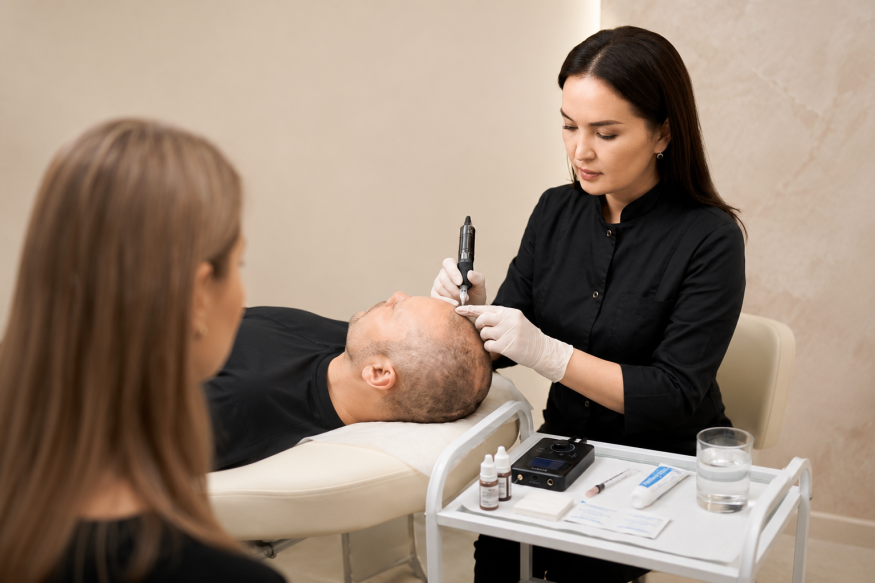
The founder of Elisa Beauty Studio, a specialist in permanent makeup and paramedical micropigmentation, discusses why an artist's work today is judged not only by the visual result, but also by technique, safety, and long-term healing.
In 2026, Elizat Sultanova joined the jury of the Eurasian Beauty Awards, an international award in the beauty industry that brings together specialists from different fields, including permanent makeup, hair styling, makeup artistry, skincare, aesthetic practices, and restorative treatments.
The jury of the award includes practicing experts and industry leaders who evaluate the professional work of participants based on quality, technique, originality, safety, and compliance with modern beauty industry standards. On the award's website, Sultanova is presented as the Founder & Lead Artist of Elisa Beauty Studio, a specialist with more than 9 years of experience, and an expert in paramedical micropigmentation for oncology patients, people with alopecia, burns, and post-surgical cases.
For Sultanova, this invitation became a continuation of her existing professional recognition. Her work had previously been recognized with certificates of honor from the Ministry of Health of the Kyrgyz Republic in 2020 and 2023, a letter of appreciation from the Ministry of Culture in 2025, inclusion in the Top 100 best beauty artists in Kyrgyzstan, as well as recognition by Top_100.world and WBC Central Asia.
We spoke with Elizat about why evaluation standards in permanent makeup are changing and what distinguishes a strong artist from simply a good technician.
Elizat, what does the invitation to join the jury of the Eurasian Beauty Awards 2026 mean to you?
For me, this is an important professional milestone. When a specialist is invited to serve on the jury of an international competition, it means that the professional community trusts not only their practical experience, but also their criteria for evaluation.
A judge does not look only at a beautiful photograph. A judge must understand what stands behind the result: whether the technique was chosen correctly, whether it suits the client's skin, how carefully the pigment was implanted, whether there was excessive trauma, and how the result will look after healing.
In permanent makeup, this is especially important because the artist's work remains on a person's face for a long time. A mistake can be not only aesthetic, but also very personal for the client.
Why is it no longer enough to evaluate work based on "before and after" photos?
A photograph shows only part of the result. On the day of the procedure, the work may look bright, even, and impressive, but that does not necessarily mean it is high-quality.
True quality becomes visible after healing. It is important to see how the pigment remains in the skin, whether the color changes, and whether the result becomes too dense, too cool-toned, or unnatural. That is why a good artist thinks not only about how the work looks today, but also about how the client will look in one month, six months, or a year.
Permanent makeup is not makeup for one evening. It is long-term work with the skin.
What criteria do you consider most important when evaluating an artist's work?
First, harmony with the client's face. The shape, color, and density must suit the specific person, rather than simply repeat a trend.
Second, technique. It is important how carefully the artist works with the skin and whether they correctly choose the depth, pressure, and pigment saturation.
Third, the healing forecast. An experienced artist understands in advance how the result may change after the procedure.
And fourth, an individual approach. Clients have different skin types, ages, medical histories, and previous procedure experiences. It is impossible to do the same thing for everyone.
You also specialize in paramedical permanent makeup. How is this field different from regular aesthetic permanent makeup?
In regular permanent makeup, clients most often come for aesthetic enhancement: to make their eyebrows more expressive, their lips brighter, or their eyes more open.
In the paramedical field, the situation is different. A client may come after cancer treatment, with alopecia, a burn, a scar, or after surgery. Here, the artist's task is not simply to improve appearance, but to help a person restore a sense of wholeness.
This work requires greater caution. The client may have altered skin, reduced sensitivity, scar tissue, and unpredictable healing. Sometimes the work has to be done in several stages. Sometimes it is necessary to wait. And sometimes the right decision is not to perform the procedure if it is not safe at that moment.
Does your experience with complex cases influence how you evaluate the work of other artists?
Yes. When you work with complex cases, you begin to look at the profession differently. It is important not just to make something beautiful, but to understand why it should be done in a particular way.
I always look for logic in the work. Why did the artist choose this shape? Why this density? Why this technique? Does it suit this specific client?
For me, a high level means that there is a professional decision behind the result. Not just a randomly beautiful picture, but conscious, thoughtful work.
Your work has been recognized by government organizations and professional rankings. Can it be said that the jury invitation became a continuation of this recognition?
Yes, that is exactly how I see it.
In 2020 and 2024, I received certificates of honor from the Ministry of Health of the Kyrgyz Republic, and in 2025, a letter of appreciation from the Ministry of Culture. I was also included in the Top 100 best beauty artists in Kyrgyzstan, and my work was recognized by Top_100.world and WBC Central Asia.
For me, these facts are important not as formal achievements, but as confirmation that my approach is noticed at different levels: by clients, colleagues, professional communities, and official organizations.
When a specialist is first recognized for their work and then invited to evaluate other artists, that is a different level of responsibility.
What mistakes most often prevent artists from reaching a high professional level?
The main mistake is working by template. The same shape, the same technique, and the same density for every client.
The second mistake is not collecting enough information before the procedure. An artist must understand whether the client has had surgeries, treatment, allergies, scars, previous permanent makeup, and how the skin healed before.
The third mistake is thinking only about the result on the day of the procedure. In permanent makeup, it is necessary to look ahead. A good artist works not for a photograph, but for the result that the person will live with.
What should modern beauty competitions be like? What should they evaluate?
Competitions should evaluate more than just the visual effect. Of course, aesthetics are important, but they are not enough.
It is necessary to look at technique, safety, case complexity, individual approach, and the quality of the result after healing. It is especially important to recognize work where the artist solves not only a cosmetic task, but also a restorative one.
Sometimes the strongest work looks very natural and calm. But that is exactly where the mastery lies: creating a result that does not attract unnecessary attention, but restores the person's confidence.
How do you see the future of permanent makeup?
I think the industry will become more professional. Fast, template-based work is gradually fading away. Clients understand better what they want, and artists need more knowledge about skin, pigments, healing, contraindications, and long-term results.
Paramedical micropigmentation will develop as a separate specialization. This field can no longer be viewed simply as a beauty service. It is connected to restoring appearance after illness, surgery, trauma, or hair loss.
That is why I think that in the future, permanent makeup specialists will more often work alongside dermatologists, trichologists, plastic surgeons, oncology centers, and rehabilitation centers.
Elizat Sultanova's inclusion in the jury of the Eurasian Beauty Awards 2026 reflects a broader shift in the permanent makeup industry. The professional community is increasingly evaluating not only a beautiful visual result, but also how that result was achieved.
For classic beauty work, shape, color, and symmetry are important. But for modern permanent makeup, that is no longer enough. Safety, technique, understanding of the skin, healing quality, and the artist's ability to work with the client's individual features are coming to the forefront.
That is why the participation of specialists with experience in paramedical permanent makeup on the juries of international competitions is important for the entire industry. It helps shift the focus from an impressive photograph to a professional standard — one by which work is evaluated not only visually, but also with an understanding of the process, responsibility, and long-term result.